This guide contains affiliate links. If you book through them, we may earn a commission at no extra cost to you. Read our disclosure.
This article is for general orientation only and is not immigration or legal advice. Entry rules can change with little notice — always confirm your own situation with the Royal Thai Embassy or Consulate in your country, or with Thai Immigration, before you book.
Whether you need a Thailand visa for Phuket depends on your passport, not on where in Thailand you’re going. The rules changed on 15 September 2026, so if you read an older blog post — including some still floating around with “60 days visa-free” in the title — it’s out of date. Here’s what applies now.
In this guide (click to expand)
In this guide
The short answer: Thailand visa for Phuket requirements
Short answer
- Western passport (US, UK, EU, Australia, Canada, ~55 others): entry stamp on arrival, good for 30 days, no visa needed
- Azerbaijan, Belarus, Serbia: visa on arrival, for a fee
- Everyone else, or staying longer / working / studying: apply for a visa in advance
- Everyone, regardless of visa status: free Thailand Digital Arrival Card (TDAC) online before landing

What changed on 15 September 2026
Thailand’s visa-exemption scheme was cut back:
- Stay length: down from 60 days to 30 days for the general exemption list.
- Eligible countries: down from 93 to 60 countries and territories (still includes the US, UK, most of the EU, Australia, New Zealand, Canada, Japan, Singapore, South Korea and the UAE, among others).
- Visa on arrival: down from 31 countries to just three — Azerbaijan, Belarus and Serbia.
- Purpose: the exemption now covers tourism only. The old version also allowed short business trips; it no longer does.
- One extension is still possible: a single 30-day extension at a local immigration office, at the officer’s discretion, for roughly 1,900 THB.
- New 15-day exemption added: Mauritius and Seychelles passport holders gained a new 15-day visa-exempt entry as part of this same reform.
If you entered Thailand before 15 September 2026 under the old rules, you keep whatever stay you were granted at the time — this only affects entries from that date onward.
The entry-limit rule — and why it matters less than it sounds for most Phuket trips
A lot of coverage of this change describes a flat “two entries per calendar year” cap. The actual rule, per Tourism Authority of Thailand, is narrower than that: the twice-a-year limit applies specifically to land-border crossings under the exemption. Flying in — which is how the large majority of Phuket visitors arrive, since it’s an island with its own international airport — is not subject to that published cap. If your trip involves a land border (crossing in from Cambodia, Laos or Malaysia, for instance), the limit does apply, and Brunei, Indonesia, Malaysia and Singapore nationals are exempt from it either way.
What didn’t change
Older bilateral agreements, separate from the general exemption list, are untouched:
- 14 days: Cambodia, Myanmar
- 30 days: China, Vietnam, Laos, Russia and several others (same length as the new general rule, just under a different agreement)
- 90 days: Argentina, Brazil, Chile, Peru, South Korea
If you want to stay longer, or for a different purpose
The 30-day stamp is for tourism, full stop. If that doesn’t cover your plans, Thailand has several visa categories worth knowing about — applied for in advance, not at the airport:
Good for
A holiday of 30 days or less, flying in, tourism only — the visa-exempt stamp covers this
Skip the exemption if
You need to work, study, retire here, or stay past 30 days — apply for one of the visa categories below instead
- Tourist Visa (TR): the standard option for a longer holiday. Typically grants 60 days and can usually be extended once at an immigration office. Apply through an embassy/consulate or Thailand’s official e-Visa portal before you fly.
- Destination Thailand Visa (DTV): aimed at remote workers, freelancers and a list of “soft power” activities (Muay Thai training, Thai cooking courses, long-stay medical treatment, and similar). Valid 5 years, allows stays of up to 180 days per entry, but requires proof of at least 500,000 THB in assets and does not permit working for a Thai employer or Thai clients.
- Retirement visa (Non-O, for those 50+): for a long stay rather than a tourist trip. The financial side typically involves either a lump sum held in a Thai bank account or a qualifying monthly income — the exact figures are set by Immigration and worth confirming directly, since they’re treated strictly and checked.
- Education visa (Non-ED): for enrolling at an accredited school, university or language program in Thailand — including the Thai-language courses some long-stay visitors use specifically to qualify for this visa category.

The straightforward way to get any of these is to arrange them before you fly, and that’s the right plan for most people. Converting status after arrival is possible for a few categories at a local immigration office — for instance, some long-stay visitors switch from a Tourist Visa to an Education or retirement-type visa without leaving the country — but it depends on your situation, isn’t guaranteed, and is handled at the immigration officer’s discretion. If a 30-day holiday isn’t really what you’re planning, it’s worth deciding which category fits and applying for it in advance rather than counting on sorting it out locally.
Thailand visa for Phuket: proof of funds — budget for 20,000 THB per person
The number to go by is 20,000 THB per person, or 40,000 THB per family. That’s the figure the Royal Thai Embassy publishes for the standard 30-day Tourist Visa Exemption — the stamp nearly every Phuket visitor flies in on — and it’s the same figure that applies if you’re holding an actual Tourist Visa (TR) or Non-Immigrant Visa. Treat this as the practical rule for planning your trip, whichever of those applies to you.
You may come across a lower 10,000 THB / 20,000 THB figure elsewhere online. On paper, that lower amount is tied to Visa on Arrival and transit visas — a narrow pair of categories (only three countries currently use Visa on Arrival: Azerbaijan, Belarus and Serbia) that covers a tiny fraction of travelers. It isn’t the number that applies to the ordinary visa-exempt stamp most readers of this article will be using, so don’t plan around it.
Be prepared to show this mainly in cash or an equivalent amount in foreign currency — that’s what official guidance leads with. Some travelers have used a bank statement or similar document instead, but it’s the immigration officer on duty who decides what they’ll accept at that moment, so don’t treat a printed statement as a guaranteed substitute for cash. Children under 12 are exempt from the requirement. Checks are made at the officer’s discretion and aren’t applied to every single arrival, but 20,000 THB per person is what you should actually be able to produce if asked.
The Thailand Digital Arrival Card (TDAC) — mandatory for everyone
Since May 2025, every foreign national who actually clears Thai immigration — entering by air, land or sea — has to submit a Digital Arrival Card, regardless of whether you need a visa. It replaced the old paper TM6 card. (If you’re only in transit and never pass through immigration control, this doesn’t apply to you.)

- Where: the official government site is tdac.immigration.go.th, and submitting it yourself there is free.
- Cost: free on the official site. You don’t need to pay anyone to file this for you — some agencies do offer to submit it on your behalf for a fee, which isn’t necessary, but isn’t automatically a scam either; a site that’s vague about being a paid middleman, or that looks like it’s impersonating the government site itself, is the kind of thing to be wary of.
- When: within 72 hours before you land. Do this before you travel — the airport is a fallback if it didn’t go through, not a plan.
- What it asks for: passport details, flight number and arrival date, a Thailand address (your first hotel is fine), and a short health declaration.
- You’ll get a QR code by email — save it or screenshot it, since you may be asked to show it at immigration.
What to actually carry to the airport
Immigration checks are inconsistent in practice, but officers can ask for any of the following, and being able to show it quickly avoids a slow queue:
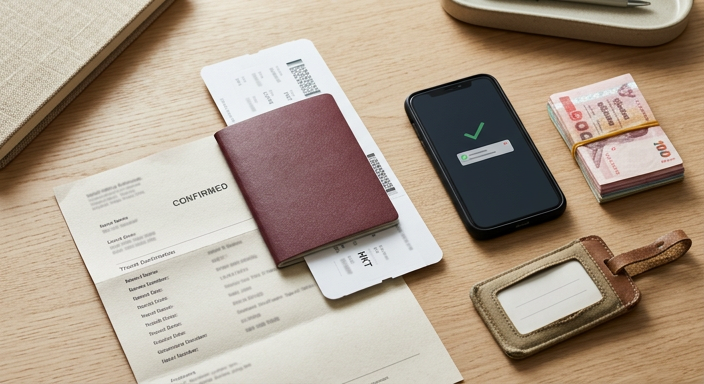
- A passport valid for at least 6 months from your entry date, with at least one blank page.
- Proof of onward or return travel — a return flight, or a ticket out of Thailand within your permitted stay.
- Proof of funds — 20,000 THB per person (40,000 THB per family), in cash, foreign-currency equivalent, or a bank statement.
- Your first night’s accommodation address — a hotel booking confirmation is the easiest way to have this ready.
- Your TDAC QR code, saved offline in case the airport Wi-Fi is slow.
None of this is unique to Phuket — it’s the same checklist whether you land in Phuket, Bangkok or Krabi — but if Phuket is your first stop in Thailand, this is where you’ll go through it.
Before you go
Once your entry route is sorted, the rest of the prep is quick: book your airport transfer, grab a Thailand eSIM so you can submit the TDAC and show your hotel confirmation on arrival, and sort travel insurance before you fly — see our guide to eSIM and staying connected in Phuket for the simple version.
Once your entry’s sorted, the next thing to lock in is where you’re actually staying.
While you’re at it, a few popular Phuket excursions are worth booking ahead too.
Related Phuket guides
- Phuket Travel Checklist
- Phuket Packing List
- Phuket Airport to Kata, Karon and Patong
- Phuket Safety: Road Risks, Scams and What to Do
FAQ
Do I need a visa to visit Phuket specifically?
No — the rule is about entering Thailand, not about Phuket as a destination. Once you’re legally in the country, you can travel anywhere in it, Phuket included.
I have dual citizenship — which passport’s rule applies?
The one you travel and check in on. If you hold two passports with different entry rules, you can usually choose, but immigration will go by the document you present.
Can I do back-to-back visa-exempt trips to stay long-term?
Flying in repeatedly isn’t capped by a published number the way land crossings are, but immigration officers can still question a pattern of frequent short visits with no clear return plan, and the exemption is explicitly for tourism only now. For a genuinely long stay, a proper visa category is the route that’s actually meant for it.
What if the TDAC site won’t load before my flight?
You can still complete it at the arrival hall on arrival — it just adds time. Try again closer to your flight, or use your phone’s data instead of airport Wi-Fi if you’re already traveling.