This guide contains affiliate links. If you book through them, we may earn a commission at no extra cost to you. Read our disclosure.
Phuket covers three completely different kinds of diving and snorkeling, each reached a different way. A short speedboat ride gets you to calm, shallow reefs that suit total beginners and snorkelers (Racha Yai and Racha Noi), or to a genuine wreck plus a shark-sanctuary pinnacle for certified divers (King Cruiser, Shark Point, Anemone Reef). Reaching the Similan Islands and Richelieu Rock — consistently rated among Thailand’s best dive sites — takes more effort: a road transfer up north plus a boat, available only part of the year. Few Thai bases give you a genuine choice between all three without relocating.
This guide covers where to dive and snorkel, what each site is actually like, how to get certified if you’ve never dived before, and when the Similans are open.
Choose your experience: snorkeling without a boat → shore spots like Ao Sane and Ya Nui; first time trying scuba, no certification → Racha Yai Discover Scuba trips; already certified and want more challenge → Shark Point, King Cruiser Wreck, or the Similans.
In this guide (click to expand)
In this guide
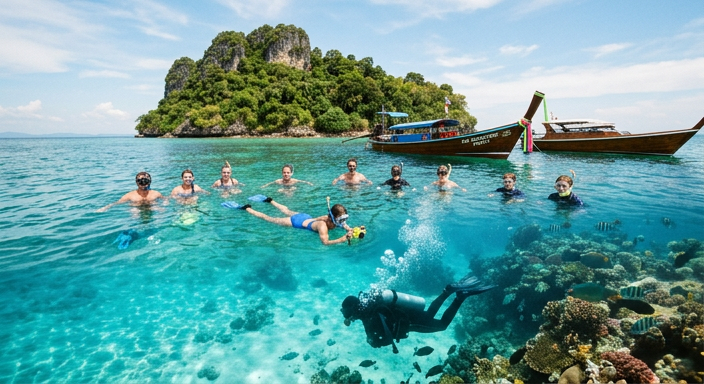
Phuket dive sites at a glance
| Site | Depth | Best for | Known for |
|---|---|---|---|
| Racha Yai | 3–30 m | Beginners, snorkelers, all levels | Artificial reef in Siam Bay, two small wrecks, garden eels |
| Racha Noi | 5–40 m | Beginners (Banana Bay) to advanced-only (South Tip) | Granite boulders, chance of mantas, well-preserved hard coral at North Point |
| Shark Point | To ~24 m | Experienced divers (current) | Resting leopard sharks, marine sanctuary since 1992 |
| Anemone Reef | Near-surface to ~30 m | Experienced divers | Anemone-covered pinnacle, leopard sharks, hawksbill turtles |
| King Cruiser Wreck | 16–31 m | Certified divers with logged dives | 85 m car-ferry wreck, sank 1997, nicknamed “Thaitanic” |
| Koh Doc Mai | To ~30 m | Certified divers, macro fans | Wall dive, seahorses, ghost pipefish, small caves |
| Similan Islands & Richelieu Rock | Varies (day trip to multi-day liveaboard) | All levels (day trip) / certified (liveaboard) | Granite islands, whale sharks and mantas in season (Dec–Apr); reached via road transfer to Khao Lak, not directly from Phuket |
Racha Yai and Racha Noi: the day trip that works for everyone
Racha Yai and Racha Noi, about an hour by speedboat from Phuket, are where most first dives and most snorkel trips happen — and where more experienced divers go when the weather elsewhere isn’t cooperating.
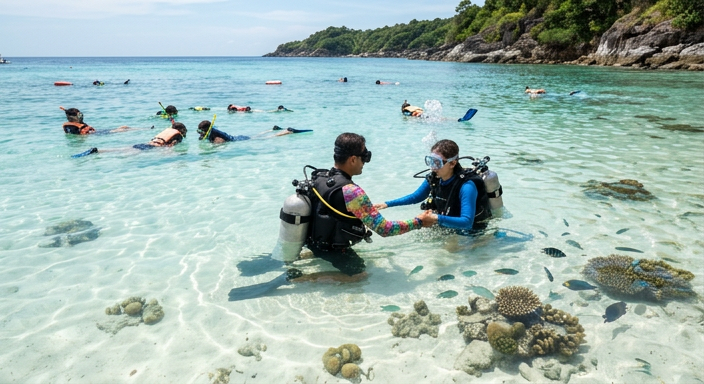
Racha Yai has calm, shallow water ideal for snorkelers and complete beginners, but it isn’t only a beginner site: Siam Bay has an artificial reef around 18 m deep (concrete and stone structures, including elephant shapes, built to rebuild coral cover) and two small wrecks, the Andaman Eagle and the Harruby, both in the mid-20s of meters and now covered in reef fish. Garden eels and stingrays sit on the sandy patches between reefs.
Racha Noi, a short hop further south, is two dive sites in one. Banana Bay is sheltered and beginner-friendly. South Tip is a different matter entirely — granite boulders starting around 14 m and dropping to 40 m or more, strong currents, and a site most operators only book for experienced, advanced-certified divers. It’s often compared to a smaller Similans because of the boulder formations and typically excellent visibility, with an outside chance of manta rays. The island’s North Point has some well-preserved hard coral.
Who this is for: anyone who hasn’t dived before, snorkelers, families, and certified divers who want an easy, reliable day out. Skip if: you’ve already done Racha Yai and want something you haven’t seen — head to Shark Point or Koh Doc Mai instead.
Shark Point, Anemone Reef and King Cruiser: the certified-diver loop
These three sites sit close together between Phuket and Koh Phi Phi and are usually dived together on a single-day, three-dive trip — the reason most Phuket dive boats run a “Shark Point and wreck” day alongside the Racha Islands day.
Shark Point has been a marine sanctuary since 1992, with fishing banned, and it earned its name from the leopard sharks that rest on the sandy bottom between its two underwater pinnacles. It’s a current-exposed site — the current direction decides which pinnacle you start at — with average visibility around 12 m, enough that divers often can’t see across to the second pinnacle. Expect scorpionfish, lionfish, moray eels, and schools of snapper and soldierfish over soft coral and seafans.
Anemone Reef, about 600 m from Shark Point, is a pinnacle that rises from roughly 30 m to just beneath the surface, covered in the anemones that give it its name. Leopard sharks, tuna, and hawksbill turtles pass through regularly.
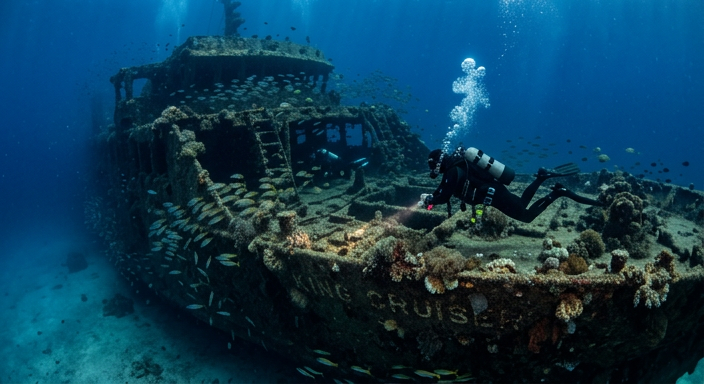
King Cruiser Wreck is the odd one out: a car ferry that sank in 1997 after hitting Anemone Reef, with no loss of life (nearby dive boats pulled everyone out). It now sits upright between 16 m and 31 m, nicknamed “Thaitanic” by local divers, home to big schools of snapper and lionfish. Penetration is no longer allowed since the car deck collapsed. This is not a site for someone’s first few dives — most operators want divers reasonably experienced before booking them on it.
Who this is for: certified divers who want more challenge and a real wreck, not just a reef. Skip if: you’re not yet certified, or you’re uncomfortable with current — go to Racha Yai or Racha Noi’s Banana Bay instead.
Koh Doc Mai: the wall dive most visitors never hear about
Koh Doc Mai is a small limestone island with a dramatic wall dropping to around 30 m — one of the better wall dives in the area, and one of the quieter sites simply because it gets less attention than Shark Point or the Racha Islands. It’s known for macro life: yellow tiger-tail seahorses and ghost pipefish along the wall, plus small caves and overhangs for experienced divers. Entering the caves requires specific training and isn’t something to attempt without it. Leopard, grey reef, and bamboo sharks are all possible here, though none are guaranteed on any single dive.
Ready to book? Compare dive and snorkel day trips covering these sites below — from a flexible Racha Island snorkel-or-dive day to a full certified-diver trip at King Cruiser and Shark Point.
Best snorkeling spots in Phuket without a boat
Not every good snorkel in Phuket needs a boat trip. Several beaches have reef close enough to shore to reach by swimming, though conditions vary a lot by tide and season:
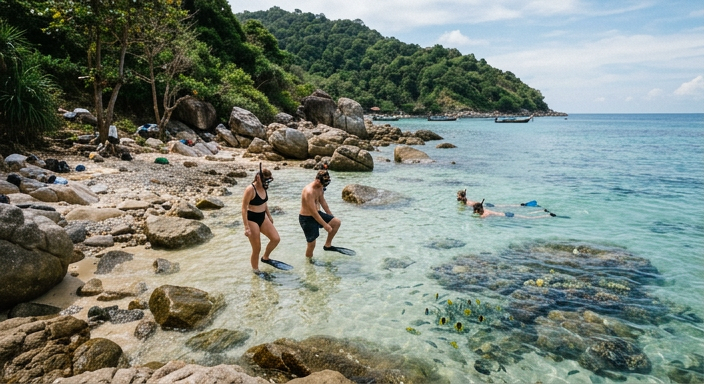
- Ao Sane (near Nai Harn): probably the most reliable shore snorkel on the island, with reef on both sides of the small bay. Conditions shift with the tide and swell even in high season, so check conditions on the day rather than assuming one side will work. Mask and fin rental is available on the beach.
- Ya Nui: a small bay with a rocky reef holding plenty of reef fish and sea urchins — keep your fins and body clear of the coral, avoid standing on the reef, and watch for urchins around the rocks. Strong swimmers sometimes cross to Koh Man, about 300 m offshore, but that’s open water with boat traffic and isn’t something to attempt casually.
- Merlin Beach (between Patong and Karon): a natural reef along part of the beach, generally calmer in the morning before the afternoon wind picks up; gear here is usually rented through the hotel rather than sold on the beach.
All three work best November to April; outside that window, swells and currents on the west coast can make shore snorkeling unsafe, and lifeguard flags should be taken seriously. Wherever you snorkel, keep clear of coral and don’t touch or stand on it — it’s slow-growing and easily damaged.
Similan Islands and Richelieu Rock: the trip worth leaving Phuket for
The Similan Islands, off Thailand’s west coast, are regularly ranked among the country’s best dive and snorkel sites — granite boulder formations similar to Racha Noi’s but on a much bigger scale, and exceptional visibility most of the season. Richelieu Rock, a horseshoe-shaped pinnacle often paired with the Similans on liveaboard itineraries, technically belongs to the neighboring Mu Ko Surin National Park rather than the Similans themselves, but the two are dived together often enough that it’s worth treating as part of the same trip. Both are known for a real — though never guaranteed — chance of whale sharks and manta rays, most often reported between December and April.
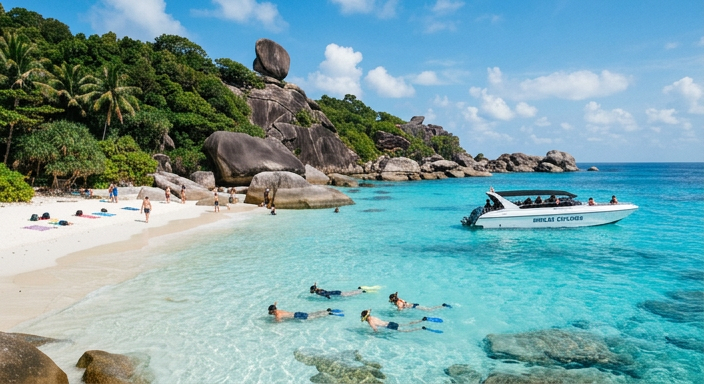
Getting there isn’t a short hop from Phuket. Organized day trips and liveaboards don’t leave from Chalong or any south-Phuket pier. Instead, you’re picked up from your hotel and driven by road to Thap Lamu Pier near Khao Lak, in Phang Nga province — the main pier most mass-market tours use — where the speedboat to the islands actually departs. Drive time depends heavily on where in Phuket you start: it’s roughly 80–100 minutes from the north of the island (near the airport) and noticeably longer, closer to two hours or more, from Patong, Phuket Town, or the south (Chalong, Rawai, Kata). Most organized trips include this transfer in the price, but what’s covered and whether there’s a surcharge for your specific pickup area depends on the operator — worth confirming before you book.
There are two ways to do it:
- Day trip by speedboat: hotel pickup very early (often before 6 am) to allow for the drive to Thap Lamu, a full day at the islands with guided snorkeling and beach time, and a return to Phuket in the evening — a genuinely long day. This suits snorkelers and anyone who wants a taste of the Similans without a liveaboard.
- Liveaboard (certified divers): multi-day boats, typically 3–7 nights, departing from the Khao Lak area and diving the Similans and Richelieu Rock repeatedly at different times of day. Prices and comfort levels vary widely between boats.
Important: Mu Ko Similan National Park closes every year for the monsoon, usually from mid-May to mid-October. For the 2026–27 season, the park reopens on 15 October 2026 and runs through 15 May 2027. No day trips or liveaboards to the Similans operate outside that window. The park also runs an official e-ticket system requiring a passport number for registration; in practice, most tour operators handle this for you using the passport details you provide when booking, but it’s worth asking whether the park fee and e-ticket are included in your tour price.
Who this is for: anyone visiting between October and May who wants Thailand’s best diving or snorkeling, not just Phuket’s, and who doesn’t mind a long day of travel either way. Skip if: you’re visiting between mid-May and mid-October — the park is closed, so stick to Racha Yai, Racha Noi, or the Shark Point loop instead. Also skip it if a long road transfer on both ends of the day isn’t something you want — the Racha Islands give you a shorter, simpler day with a similar beginner-friendly feel.
Learning to dive in Phuket
Phuket has dozens of dive schools, so if you’ve never dived before, you don’t need to go anywhere else to get certified.
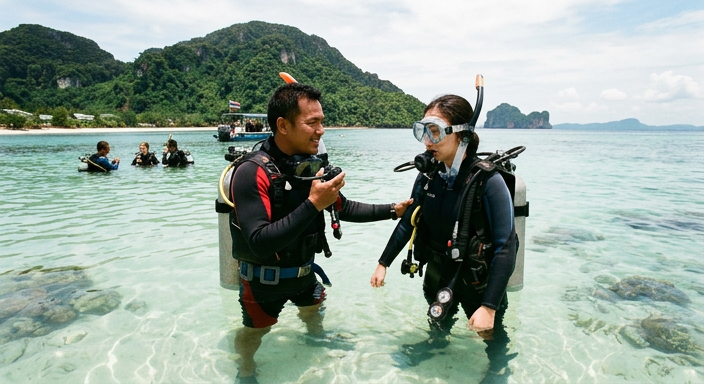
- Discover Scuba Diving (no certification or experience needed): a one-day taster, typically including two shallow dives around Racha Yai with an instructor, full equipment, and hotel transfers. It’s a supervised introductory experience, not a diving certification — if you want to dive independently on future trips, you’ll still need an Open Water course. Prices vary by operator and number of dives — budget roughly ฿3,500–5,000 ($100–160).
- PADI/SSI Open Water Diver (the entry-level certification, valid worldwide): usually a 3-day course — e-learning or classroom theory, a pool or confined-water session, then open-water training dives, often at the Racha Islands. Prices vary widely by school and group size, roughly ฿14,000–19,000 ($400–550) for a standard course. You’ll also need to pass a basic swim test before open-water training: swim 200 m non-stop (any stroke, no time limit) or 300 m wearing mask, fins and snorkel, plus float or tread water for 10 minutes.
Flying after diving: the standard guidance is to wait at least 12 hours after a single no-decompression dive, and at least 18 hours after multiple dives in a day or over several days — which covers almost every recreational dive in this guide. If a dive involved mandatory decompression stops (not typical for anything listed here), a longer interval, often 24 hours or more, is recommended. Always follow your instructor’s and dive computer’s specific guidance over any general rule.
Where to stay for diving in Phuket
It depends which trip you’re planning. Boats to the Racha Islands, Shark Point, Anemone Reef, King Cruiser Wreck and Koh Doc Mai leave from piers in the south of Phuket, around Chalong, which is why most Phuket-based dive shops are clustered in Chalong, Rawai, and Kata — staying there shaves time off an early-morning pickup for any of these day trips.
The Similans are different, and the direction matters: Thap Lamu Pier is north of Phuket, toward Khao Lak, so staying in the north of the island (near the airport, Nai Yang, or Bang Tao) actually cuts a meaningful chunk off that transfer compared with Chalong, Rawai, or Kata in the south — roughly 80–100 minutes versus closer to two hours or more. If the Similans are the main reason for your trip, Khao Lak itself is the most convenient base of all; staying in Phuket and accepting the longer drive only makes sense if you want everything else Phuket offers too.
Most dive and snorkel day trips include hotel transfers, but a rental car or scooter gives you the freedom to reach Chalong Pier early or explore between dives on your own schedule. See getting around Phuket for the basics, and compare cars here:
The map below shows hotels around Chalong, Rawai and Kata — the most convenient base for every dive site except the Similans.
Mistakes to avoid
Assuming Similan trips leave from Phuket directly. They don’t — budget for the road transfer to Thap Lamu Pier near Khao Lak. If the Similans matter most to you, a hotel in north Phuket (or Khao Lak itself) genuinely shortens that drive versus staying in the south.
Booking a liveaboard or Similan day trip outside the October–May season, or without an e-ticket. The park requires advance e-ticket registration with a passport number; check current dates before booking anything.
Assuming any Phuket day trip includes diving. Many boats to Racha Yai and the Similans are snorkel-only or offer diving as a paid add-on; confirm before booking if diving matters to you.
Booking King Cruiser Wreck, Shark Point, or Racha Noi’s South Tip as a first dive. Current and depth make these unsuitable for beginners — start at Racha Yai or Racha Noi’s Banana Bay instead.
Flying too soon after diving. It depends on how many dives you did and over how many days — see the guidance above.
Before you go
Best season: November to April generally has the calmest seas and best visibility on both coasts; the Similans are only accessible mid-October to mid-May. What to bring: your own mask if you have one (rental masks rarely fit as well), a rash guard or light wetsuit for sun and jellyfish protection, and a dry bag for the boat. Certification card: bring your physical or digital PADI/SSI card if you’re already certified — schools need to see it before letting you dive beyond beginner sites. Add insurance, a local eSIM and your return transfer before you fly.
Phuket diving and snorkeling: FAQ
Do I need to be a strong swimmer to try diving in Phuket?
You need to be reasonably comfortable in water, but Discover Scuba courses are designed for complete beginners and don’t require strong swimming ability. Check the specific operator’s requirements if you have any health conditions, since most exclude divers with certain heart, lung, or ear conditions.
Can I see whale sharks in Phuket?
Whale sharks are occasionally seen at Shark Point and more reliably reported around the Similan Islands and Richelieu Rock between December and April, but no operator can guarantee a sighting on any given trip.
Is Phuket diving good for beginners, or only advanced divers?
Both. Racha Yai and Racha Noi’s Banana Bay are genuinely beginner-friendly, while Shark Point, Anemone Reef, King Cruiser Wreck, Koh Doc Mai, and Racha Noi’s South Tip suit certified, more experienced divers.
Can I snorkel in Phuket without taking a boat?
Yes — Ao Sane, Ya Nui, and Merlin Beach all have reef close enough to reach by swimming, best between November and April. Conditions depend on tide and season, so check before you go.
Do Similan Islands trips really leave from Phuket?
They’re sold and picked up from Phuket hotels, but the boat itself departs from Thap Lamu Pier near Khao Lak, about 80 minutes to two hours away depending on where you start. That transfer is included in the trip price but adds real time to the day.