This guide contains affiliate links. If you book through them, we may earn a commission at no extra cost to you. Read our disclosure.
Getting around Phuket decides more of your holiday than most people expect. There is no metro, the beaches sit in separate bays divided by steep hills, and the same short ride can cost 100 baht in a ride app or 300 baht from a tuk-tuk on Bangla Road. Get it right and an evening out in Patong, a morning in the Old Town or a sunset at Promthep Cape is easy and cheap. Get it wrong and taxis quietly eat your budget. Most visitors end up combining three things: Grab or Bolt for short hops, the Smart Bus or blue buses for budget trips by day, and a rental car if they stay away from Patong or travel with children.
Short answer
- Short rides and evenings out: Grab or Bolt; usually the cheapest car option and no haggling
- Airport to the west-coast beaches on a budget: the Smart Bus, 100 baht flat
- Phuket Town to a beach for pocket change: the blue songthaew buses, 30–50 baht
- Exploring the island or travelling with kids: a rental car for a few days
- Avoid: getting into a tuk-tuk without agreeing the price first
In this guide (click to expand)
Phuket transport at a glance
| Option | Typical price | Good for | Watch out for |
|---|---|---|---|
| Grab / Bolt / inDrive | Grab or Bolt: about 80–120 baht for 2–3 km; about 180–250 baht Patong to Kata or Karon. inDrive: you propose the fare | Most trips, evenings | Surge pricing at busy times and in rain |
| Tuk-tuk / red taxi | often 200–400 baht within one beach area; 500–800 baht or more between beaches | When no app car is nearby | Agree the price first |
| Metered taxi | varies; often a fixed price instead of the meter | Groups with luggage | Many drivers will not use the meter |
| Blue bus (songthaew) | 30–50 baht from Phuket Town | Budget trips by day | Only to and from Phuket Town, about 6 am–6 pm |
| Smart Bus, Route 1 | 100 baht flat | Airport and west-coast beaches | Every 30–60 minutes; stops on the main road |
| Rental car | from about 600 baht a day in low season | Exploring, families | International Driving Permit needed |
Grab and Bolt: the easiest way of getting around Phuket
Ride apps are the simplest way to get around Phuket. You see the price before you book, pay by card or cash, and skip the haggling. Grab has the most drivers; Bolt is often cheaper but has fewer cars, so waits can be longer in quiet areas such as Rawai or Nai Harn. A third app, inDrive, lets you propose your own fare and choose between driver offers; it has fewer cars, payment is usually in cash, and quotes can be higher in quiet areas, so compare all three before you book. Grab has an official pick-up point at the airport; Bolt and inDrive are licensed in Phuket, but in March 2026 the airport had not yet approved them for pick-ups there. Picture the end of a night in Patong: instead of bargaining with a row of tuk-tuk drivers, you tap the app and a car takes you back to Kata for a fixed fare. Prices jump at rush hour, late at night and when it rains, so compare the quote before you confirm.
You need mobile data for all of this, from the moment you land. An eSIM installed at home usually connects as soon as you land; with some plans you first need to turn on the eSIM line, choose it for mobile data and allow data roaming.
Tuk-tuks and taxis
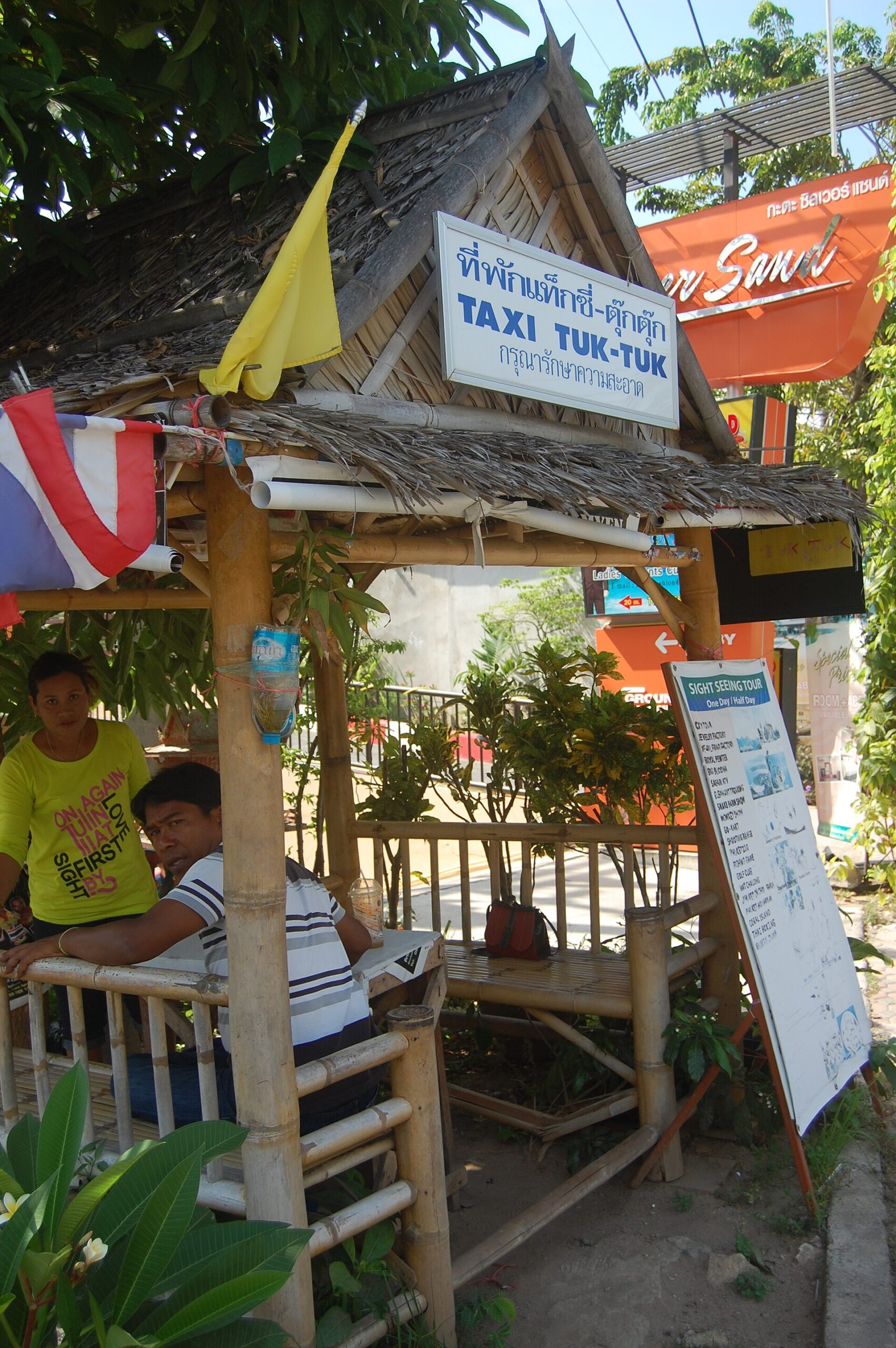
Phuket’s tuk-tuks are small vans painted red, yellow or green, and they are known for high prices. They do not use meters: agree the fare before you get in, and walk away if the driver says you will “talk about it later”. For longer trips an app car is usually cheaper and more comfortable. Some hotels have taxi desks with posted prices, a safe if not cheap option.
Motorbike taxis. Riders in coloured vests wait at corners, markets and busy beach streets, and GrabBike is available in the Grab app. They are quick for one person with light luggage, and in a traffic jam they are the fastest option. Agree the price before you get on, and ask for a helmet: wearing one is the law, with a fine of 2,000 baht. Two-wheeled transport carries a higher risk than a car, especially on wet roads and steep hills.
Blue buses (songthaew) from Phuket Town
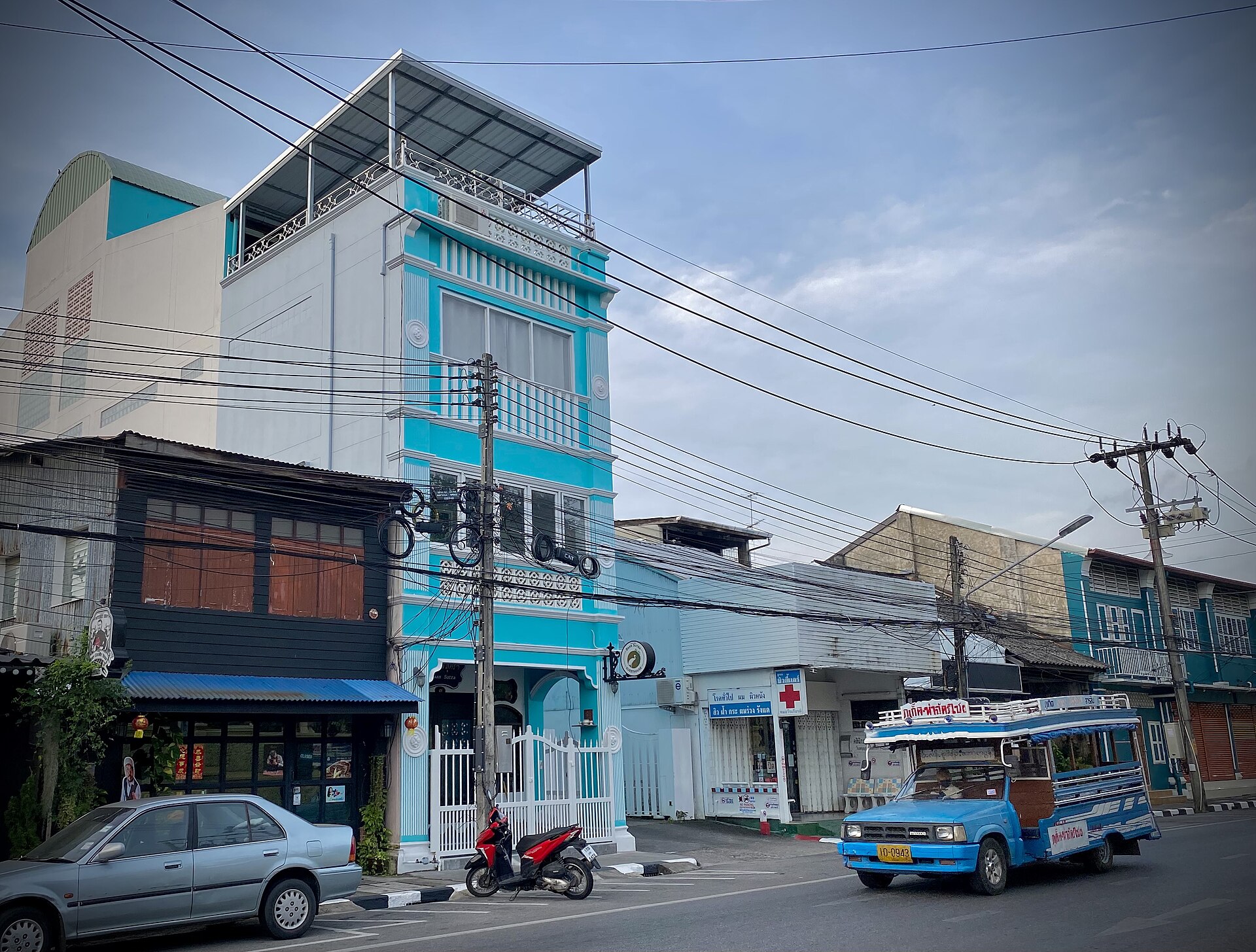
The traditional blue wooden buses leave from the market area on Ranong Road in Phuket Town, roughly every 30 minutes from about 6 am to 6 pm. Fares at the time of checking: about 30 baht to Patong, Karon, Kata and Chalong, 35 baht to Rawai and Nai Harn, and 40–50 baht to Kamala, Surin and Bang Tao.
The open sides and slow pace are part of the charm. The catch: each route only connects Phuket Town with one stretch of coast, so you cannot hop between beaches, and there is no service in the evening. They work best for a day in the Old Town from your beach.
Phuket Smart Bus
The air-conditioned Smart Bus is the island’s modern public transport. Route 1 runs from the airport down the west coast through Bang Tao, Surin, Kamala, Patong, Karon and Kata to Rawai for a flat 100 baht, departing about every 30 to 60 minutes from about 8 am to late evening, depending on the current timetable. Route 2 links the bus terminal in Phuket Town with Patong for 50 baht, and the Dragon Line loops around Phuket Old Town free of charge. Check departures on the official Smart Bus timetable.
Other buses. The orange Airport Bus runs between the airport and the old bus terminal in Phuket Town for about 100 baht, which is a different route from the Smart Bus along the west coast. In Phuket Town itself, electric city buses replaced the old pink buses in 2025 and run on a few short lines with low fares; check the current routes in the Phuket OneMap app.
You can pay in cash, by QR code or with a contactless Visa or Mastercard, and day passes exist for frequent riders. It is the cheapest way from the airport to the beaches, but it stops on the main road, not at hotels; check the latest timetable before relying on it.
Renting a car or scooter
If you want quiet beaches, viewpoints and the Old Town on your own schedule, a rental car can pay for itself if you make regular trips to different parts of the island, especially for families or anyone staying in Bang Tao, Nai Harn or Mai Khao. If you spend most days at the hotel and one beach, taxis may cost less. You need an International Driving Permit together with your home licence. Scooters are cheap, but they carry a higher risk of accidents than a car, especially on wet roads and steep hills; you need a motorcycle licence and an IDP that covers it to ride legally. Our guide to renting a car in Phuket covers prices by month, deposits and insurance.
Which option fits your trip
The best way of getting around Phuket depends mostly on where you stay and who you travel with:
- Staying in Patong or Kata, beach days only: walk, plus Grab for the odd trip.
- Bang Tao, Nai Harn or Mai Khao: often a rental car, or budget for app rides every day.
- Family with kids: a car with child seats, or pre-booked transfers for longer trips.
- Budget traveller: blue buses and the Smart Bus by day, Bolt in the evening.
- A day in the Old Town: blue bus in (or Smart Bus Route 2 from Patong), the free Dragon Line around town, Grab back after dark.
Just arriving? Our guide to getting from Phuket Airport to Kata, Karon and Patong compares transfers, taxis and buses, and where to stay in Phuket helps you pick a base where you need less transport in the first place.
Getting around Phuket FAQ
Is Grab available in Phuket?
Yes. Grab and Bolt both operate across Phuket and are usually cheaper than tuk-tuks and street taxis.
How much is a tuk-tuk from Patong to Kata?
There is no meter, so expect to negotiate and to pay more than an app car, which usually costs around 180–250 baht for this route outside peak times.
Is there public transport in Phuket?
Yes, but Phuket transport is limited: blue songthaew buses from Phuket Town to the beaches during the day, and the Smart Bus between the airport and Rawai, plus a Phuket Town–Patong route and a free Old Town loop.
Can I pay for the Smart Bus by card?
Yes. The Smart Bus accepts cash, QR payment and contactless Visa or Mastercard, and sells day passes.
Do I need a car in Phuket?
Not if you stay in Patong or Kata and mostly go to the beach. For the north and south of the island, or with children, a car makes things much easier.
More for your trip: all our guides in one place in the Phuket Travel Guide.
Cover photo: edwin.11 / Wikimedia Commons, CC BY 2.0.