Phu Quoc temples and pagodas number more than a dozen across the island, and almost no visitor sees all of them in one trip. Most people end up at just one — usually Ho Quoc Pagoda, because every tour that stops at Sao Beach or the Hon Thom cable car swings by it. The rest are scattered between Duong Dong town, the hillsides near the airport, and the quieter northern coast, and they reward very different kinds of visits: a quick stop between beaches, a slow walk through town, or a detour that only makes sense if you’re already heading that way.
This guide groups them by where they actually sit on the island, so you can match a temple to whatever part of Phu Quoc you’re in that day, rather than trying to chase all eleven in a single loop.
Table of Contents
Duong Dong town: five stops within walking distance of each other
This cluster of Phu Quoc temples works as a single late-afternoon walk if you’re staying anywhere near Duong Dong or the night market. None of them need more than 20-30 minutes, and several sit within a few hundred meters of each other.
Dinh Cau Temple is the one almost everyone sees, because it sits on a rock outcrop right at the mouth of the Duong Dong River, with a small lighthouse attached. It was built in 1937 and is dedicated to Thien Hau, the sea goddess fishermen pray to before heading out. Climb the 29 stone steps to the rooftop terrace and you get a view over the fishing boats, the river mouth, and the town itself — it’s the best sunset spot in this cluster, which also means it gets crowded right at golden hour. Free entry, open roughly 7am-6pm, allow 15-20 minutes unless you’re staying for the sunset.
Sung Hung Pagoda, a short walk away on Tran Hung Dao Street, is generally called the island’s oldest pagoda — it formed from the merger of two earlier pagodas and keeps most of its original layout: a three-gate entrance, a shaded courtyard, a reclining Buddha outside, and a main hall with a Goddess of Mercy statue set in a small lotus pond. It isn’t large or especially ornate by Vietnamese standards, but it’s calm despite being close to the busiest street in town. Free, roughly 7am-6pm, allow 15-30 minutes.
Dinh Ba Thuy Long Thanh Mau Temple sits about 100 meters from Dinh Cau, near the harbor — worth flagging because there’s a second, unrelated shrine also called “Dinh Ba” much further north (more on that below; they’re easy to mix up). This one honors Thuy Long Thanh Mau, the sea goddess locals credit with having discovered the island, and it’s a working shrine rather than a sightseeing stop — a colorful gate with dragon and guardian statues, a symmetrical main hall in red, gold, and green, and murals along the walls. No fee, shoes off before entering, 10-15 minutes.
Cao Dai Temple, on Nguyen Trai Street, is worth a look even if you know nothing about Cao Dai, a 20th-century Vietnamese religion that blends Buddhist, Christian, and Islamic symbolism under the Divine Eye. The building is easy to spot from the street — two tall towers in pastel colors — and the prayer hall inside is simple and symmetrical. It’s sometimes closed depending on temple activity, so this is a stop to check rather than count on. Free, 10-20 minutes.
Phap Quang Pagoda, further down Tran Hung Dao Street in Duong To, is a Chinese Buddhist pagoda built in 1986 and last renovated in 1992. The main feature is the row of Arhat statues, each with a different expression, lining the path to the halls dedicated to Avalokiteshvara and Ksitigarbha. It’s the least visited of the five here, mostly because it’s a few minutes further out and doesn’t show up on as many lists — which also makes it the quietest.
South and central Phu Quoc: the hillside pagodas
This is where Phu Quoc’s two best-known pagodas sit, plus a much smaller shrine that almost no tour mentions.
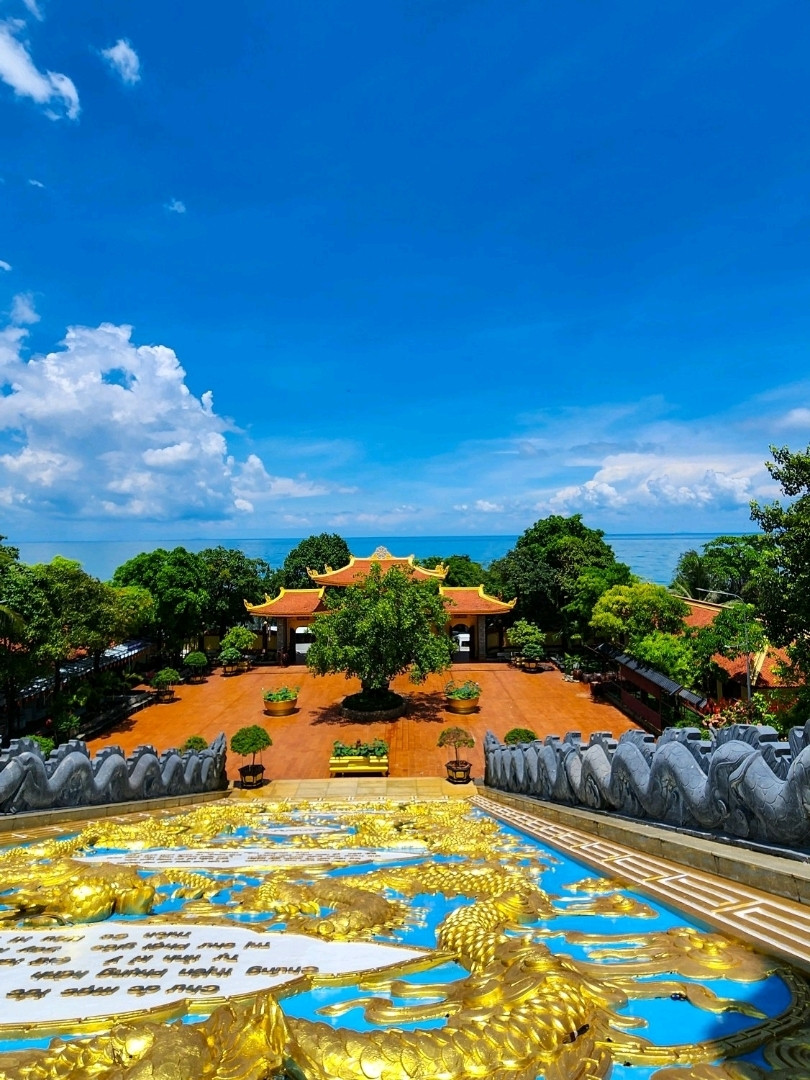
Ho Quoc Pagoda is the island’s largest and most photographed temple, built in 2012 in Ly-Tran dynasty style on a hillside on the east coast, between the airport area and An Thoi (about 15km from the airport, 12km from An Thoi). The golden dragon staircase, the white Guanyin statue overlooking the sea, and the halls, ponds, and bridges around the complex make it genuinely worth the detour — the name translates roughly to “protecting the country.”
Free entry and parking, open daily 6am-6pm. It gets busy with tour groups by midday, so morning works better, and sunrise is the time locals recommend if you want the complex closer to empty. Allow 45-60 minutes. It pairs naturally with Bai Sao Beach, the Phu Quoc Prison site, An Thoi, and the Hon Thom cable car, all nearby.
⚖ The trade-off: Ho Quoc is the more impressive complex, but by late morning it’s full of tour groups. Su Muon is quieter and easier to have mostly to yourself, but it’s a smaller, simpler site without the sea views.
✓ Best for: travelers who want the classic Phu Quoc temple photo and don’t mind sharing it with tour groups, or anyone visiting at sunrise.
✗ Skip if: you’re short on time and already have a packed south-island itinerary — Su Muon gives a calmer version of the same idea closer to town.
Su Muon Pagoda (also called Hung Long Tu), in Suoi Da hamlet about 5km west of Duong Dong — the same general direction as the airport — is the quieter alternative: a green hillside temple from 1932 with a reclining Buddha on the hill, golden-relief backdrop, and green dragon statues forming the main scene, plus a Laughing Buddha section and a small lotus-born Buddha figure.
We visited in early May and had the place almost to ourselves — walked up slowly to the reclining Buddha, took photos without any crowds, and had no trouble parking after driving up. The road up isn’t difficult, just a short climb among the trees. The pagoda’s balcony looks out toward Ham Ninh Mountain and the coast, though the pagoda itself isn’t on the way to Ham Ninh. Allow around an hour, dress respectfully, and keep quiet near the prayer areas. It combines well with Suoi Tranh or anything else in this part of the island.
The Gia Long shrine near Giếng Tiên, close to Bãi Khem (Khem Beach) in the far south of the island near An Thoi, is the one most visitors never hear about. It’s a small golden shrine — locally known as “Đền Thờ vua Gia Long,” recorded elsewhere as Đền Minh Vương — tied to a local legend: Emperor Gia Long, hiding from the Tay Son forces with his troops and no fresh water, is said to have thrust his sword into the ground and prayed, and a spring rose from the spot. Locals later built the shrine at the well.
We found it mostly by accident near An Thoi, and it was temporarily closed when we visited — we couldn’t get inside, so we can’t describe the interior. Realistically, this is a 10-15 minute stop if you’re already passing through the southern beaches, not a place to plan a dedicated trip around. Among all the Phu Quoc temples in this guide, it’s the one purely for the curious rather than the devout.
North Phu Quoc: two stops that only make sense together
These two Phu Quoc temples sit far enough from everything else in the north that they’re worth combining into one trip rather than visiting separately.
Nguyen Trung Truc Temple, in Ganh Dau at the island’s northern tip, honors the 19th-century national hero who was captured in this area and later executed in Rach Gia on the mainland — a separate, larger temple to him exists there too, which is a common source of confusion online. This one feels like an actual neighborhood place of worship rather than a tourist stop: a modest hall with his portrait, a statue, a memorial tablet, and model wooden boats, set in a quiet courtyard.
Most signage is in Vietnamese. Free, no posted hours (daylight hours generally work), allow 15-30 minutes, longer if you want to read up on the history first. Combine it with the Ganh Dau fishing village and coastal viewpoints nearby.
The coastal Dinh Bà shrine, further along the route toward Rạch Vẹm and Starfish Beach, is a small shrine that’s been standing since the 1930s — golden dragons, red lanterns, a turtle statue, a Guanyin figure, and a sea-facing altar, dedicated to a southern Vietnamese folk goddess. We stopped here on the way between Su Muon Pagoda and Starfish Beach; it’s not a destination on its own, but a natural 20-30 minute pause if you’re already exploring toward the north coast.
Two smaller temples — Hung Quoc Tu, built in 1952, and Le Kim Dinh Temple, honoring the wife of Nguyen Trung Truc — also show up on the island, but with little documented beyond their names and basic history; they’re worth knowing exist if you’re a completist, but not detours on their own.
Phu Quoc Temples: Picking a Realistic Route
Trying to see all eleven in one day means a lot of driving for diminishing returns. A more realistic split: the five Duong Dong temples as one town walk, Ho Quoc and Su Muon as a south-island half-day (easily combined with Sao Beach or An Thoi), and the two northern stops folded into whatever takes you up toward Starfish Beach anyway. The Gia Long shrine is worth keeping in mind only if you’re already in the deep south near An Thoi — it’s not worth routing a whole day around.
Several of these — Su Muon, the coastal Dinh Bà shrine, Nguyen Trung Truc — are easiest to reach with your own wheels rather than relying on taxis for each stop. For more on this part of Vietnam, browse our full Phu Quoc coverage.
Before you go
Most of these Phu Quoc temples are easiest to visit from a base in or near Duong Dong, within reach of the town cluster and a short drive from the hillside pagodas further south. Use the map below to see hotels around the main temple areas before you book.
If you’ve settled on which Phu Quoc temples to visit and you’re still sorting out the basics of the trip itself: